
Why Headlights Streak and Halo at Night With Astigmatism

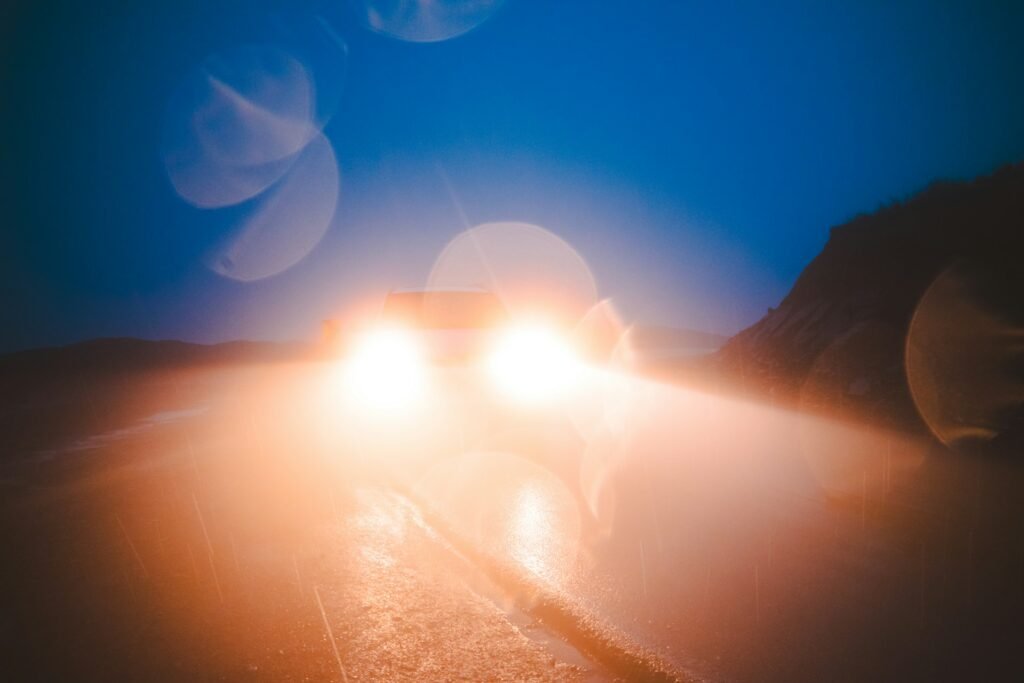
Astigmatism spreads a point of light into a streak because your cornea focuses light along two axes instead of one. At night, your pupil opens wider, light enters through more of that uneven surface, and a headlight that looked like a dot in daylight turns into a starburst. It’s the single most common reason night driving feels harder than it should.
Quick Takeaways
- The streaks aren’t in the lights. They’re in how your eye focuses them.
- It’s worse at night because a wider pupil uses more of the uneven cornea.
- Astigmatism is the most likely cause, not the only one. Cataracts do this too.
- Halos with eye pain and a red eye is an emergency, not a prescription problem.
- Yellow night-driving glasses didn’t improve pedestrian detection when they were tested.
Why do lights streak and halo at night with astigmatism?
Because a point of light never lands as a point. An astigmatic cornea is curved more steeply in one direction than the other, so instead of bringing light to a single focus it spreads it along a line. The National Eye Institute lists “seeing a glare or halo around bright lights” among the symptoms of refractive errors.
A normally shaped cornea curves like a basketball. An astigmatic one curves more like a rugby ball, steeper across one axis than the other.
During the day this shows up as vision that’s slightly soft at every distance. At night, against a dark background, a single bright source gives your eye nothing to average out, and the error becomes visible as a shape.
What do lights look like with astigmatism?
Most people describe streaks radiating out from the light, like a star or a smear, usually running the same direction from every light they look at. Some see doubling, some see a soft halo around the edge. Someone without astigmatism sees a bright dot with a small amount of scatter.
The detail that tells you it’s refractive rather than something else: the streaks point the same way every time. They follow the axis of your cornea, so every headlight, every street lamp and every traffic signal smears along the same diagonal.
It’s also usually different between your two eyes, because the axis rarely matches. Cover one eye, then the other, and the pattern often rotates.
Why is it so much worse at night?
Your pupil. In daylight, it narrows to a couple of millimetres, and light passes through the middle of the cornea, which is the most regular part. In the dark it opens up, light comes in through the outer cornea as well, and the unevenness out there gets added to the picture.
This is why a prescription that feels fine at your desk can feel useless on a dark road. Nothing about your eye changed. The aperture did.
Two other things stack on top of it. Contrast collapses at night, so a bright source against black is the hardest thing your eye is asked to do. And modern LED headlights put out a sharper, bluer, more concentrated beam than the halogens most of us learned to drive with, which gives the smear more to work with.
Is it always astigmatism?
No, and this is the part the eyewear sites skip. Halos around lights and trouble seeing at night are also listed by the NEI among cataract symptoms. Dry eye scatters light the same way. And halos with eye pain and a red eye is something else entirely.
| What you’re seeing | Likely cause | Other signs | What to do |
|---|---|---|---|
| Streaks radiating the same direction from every light | Astigmatism | Vision slightly soft at all distances, squinting helps a little | Book a routine eye exam |
| Halos plus lights seeming too bright, colors faded | Cataract | Prescription changing often, vision cloudy | Book an eye exam, mention the glare |
| Halos that clear when you blink | Dry eye | Gritty or burning eyes, worse on screens | Book an eye exam |
| New or suddenly worse streaking | Prescription out of date, or a change worth checking | Distance vision also softer than it was | Book an eye exam |
| Halos with severe eye pain, a red eye, nausea | Acute angle-closure glaucoma | Sudden onset, over hours | Emergency care the same day |
The one that can’t wait. Halos around lights combined with intense eye pain, a red eye and nausea is how acute angle-closure glaucoma presents. It comes on over hours, not months, and vision lost to an untreated attack doesn’t come back. That needs emergency care today, not an appointment next week.
The practical version: if correcting your astigmatism doesn’t fix the streaking, the streaking was never only astigmatism.
Do night driving glasses work?
The yellow-tinted ones don’t, based on the evidence we have. A 2019 study in JAMA Ophthalmology tested three yellow-lens night-driving products against clear lenses in a driving simulator and concluded they “did not appear to improve pedestrian detection at night.” Response times with the yellow lenses were slightly longer, not shorter.
Worth knowing what that study was and wasn’t. Hwang, Tuccar-Burak and Peli ran 22 participants through a simulator with a custom headlight-glare rig. Twenty-two people is a small sample and a simulator isn’t a road. The slightly worse response times with yellow lenses didn’t reach statistical significance.
What it does tell you is that there’s no evidence they help, and a plausible mechanism for why they wouldn’t: a yellow tint cuts the total light reaching your eye. On a dark road, less light is not the problem you’re trying to solve.
Anti-reflective coating on a clear prescription lens is a different thing, and it’s the one worth having. It cuts the reflections bouncing off the lens surfaces themselves, which is a real source of the ghosting around oncoming headlights.
What actually helps when driving at night
An accurate, current prescription does most of the work. Astigmatism is corrected with a cylinder value set to a specific axis, and a small error in that axis costs you more at night than it does during the day, precisely when you need it most.
- Get the prescription right and keep it current. The axis matters as much as the power. If yours is a few years old, that’s the first thing to fix.
- Add anti-reflective coating. It removes reflections generated inside your own lenses, which is the ghosting layered on top of the streaks.
- Clean both the lenses and the windshield, inside and out. A film on the inside of a windshield turns every oncoming headlight into a bloom. Most people never clean that side.
- Dim the dashboard. A bright dash keeps your pupils constricted and your eyes adapting back and forth instead of settling into the dark.
- Look to the right edge of your lane when a car approaches. It keeps you tracking the road rather than staring into the beam.
If you wear contact lenses, the fit matters more than it does by day. A toric lens has to stay oriented on the eye to correct the axis, and one that rotates gives you intermittent blur exactly when a stable image is worth most. That’s a fitting question rather than a lens-brand question.
Getting your night vision checked in Jersey City
Bring it up specifically when you book. “Headlights streak at night” changes what we measure, because it points at the cylinder axis, the tear film and the lens inside your eye, and those are three different tests.
Vista Vision is open seven days a week at 100 14th Street in Jersey City, inside Target. A comprehensive eye exam covers all three, so you leave knowing which of them it is rather than guessing.
Common questions about astigmatism and night vision
Does astigmatism get worse at night?
The astigmatism itself doesn’t change. What changes is your pupil. A wider pupil in the dark lets light through more of the uneven cornea, so the same amount of astigmatism produces a bigger visible effect. Your measurement in the chair is the same at midnight as it is at noon.
Why do I still see halos with my glasses on?
Three possibilities worth checking. The prescription may be out of date, particularly the axis. The lenses may lack anti-reflective coating, so they’re generating reflections of their own. Or the halos aren’t refractive at all, which is what the table above is for. If new glasses didn’t fix it, that’s useful information rather than a failure.
Is it safe to drive at night with astigmatism?
With it corrected, generally yes. Uncorrected is the question worth taking seriously, because the effect is largest in exactly the conditions where reaction time matters. If you’re avoiding night driving, or arriving tense from it, that’s worth an exam rather than a workaround.
Book an eye exam in Jersey City
Seven days a week at 100 14th Street, inside Target. Most medical and vision plans accepted, including Medicare and Medicaid.
Owner and lead optometrist at Vista Vision in Jersey City, focused on glaucoma and dry eye. View full profile →
This article is general information, not medical advice, and it can’t diagnose you. Halos around lights with severe eye pain, a red eye and nausea needs emergency care the same day. For anything else, book a comprehensive eye exam.