
Astigmatism Symptoms: How to Tell If You Have It

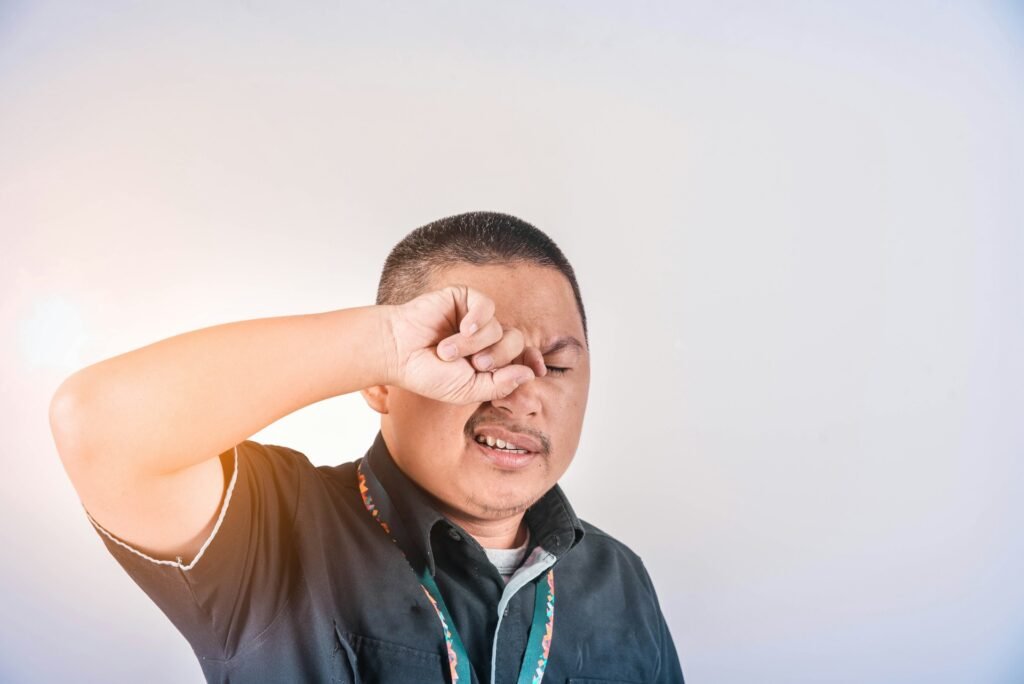
The National Eye Institute lists five symptoms of astigmatism: blurry vision, squinting to see clearly, headaches, eye strain, and trouble seeing at night. The one that separates it from ordinary short-sightedness is that the blur sits at every distance, near and far, instead of only far away.
Quick Takeaways
- Blur at all distances is the sign that points to astigmatism rather than myopia.
- Headlights that streak or halo at night are the symptom most people describe first.
- Mild astigmatism can produce no symptoms at all and still show up on an exam.
- Nobody can tell you how common it is. Three US studies put it between 11% and 46%.
- Glasses, toric contacts and surgery all correct it. Doing nothing is also an option when it’s mild.
What are the symptoms of astigmatism?
The National Eye Institute names five: blurry vision, squinting to see clearly, headaches, eye strain, and trouble seeing at night. The American Optometric Association describes the same picture as blurred vision at any distance, eye discomfort and headaches.
Read that list, and you’ll notice most of it could describe a dozen things. Tired eyes and headaches come from screens, sleep and stress as easily as from your cornea.
The symptom that actually points at astigmatism is the night one. Point lights, headlights, street lamps, the moon, stop looking like points and start looking like streaks, starbursts or smears. That’s what an uneven cornea does to a bright light against a dark background.
How does astigmatism affect your vision?
Astigmatism blurs vision at every distance. Your cornea or lens is shaped unevenly, so light focuses at more than one point on your retina instead of landing on a single one. Nothing is ever quite sharp, rather than distance being soft while reading stays crisp.
A normally shaped cornea curves like a basketball, the same in every direction. An astigmatic one curves more like a rugby ball, steeper across one axis than the other.
That difference is why the distance test matters more than any single symptom.
Points to astigmatism
- Blur at near and far
- Streaked or haloed lights at night
- Text looks slightly doubled or shadowed
- Squinting helps a little, never fully
Points elsewhere
- Only distance is blurred, so likely myopia
- Only close work is blurred, so likely presbyopia
- One eye changed suddenly, which needs checking now
That last one matters. Gradual blur in both eyes is refractive. Sudden blur in one eye is a different problem and shouldn’t wait for a routine appointment.
How common is astigmatism?
There is no single defensible number. A 2023 systematic review found three US studies reporting 11%, 36% and 46%, because each one used a different threshold for what counts as astigmatism. Neither the NEI nor the AOA publishes a figure at all.
| US study | Threshold used | Ages | People | Found |
|---|---|---|---|---|
| Sandhu et al. | ≥0.75 D | 40+ | 4,272 | 11% |
| Vitale et al. | ≥1.00 D | 20+ | 14,213 | 36% |
| Varma et al. | >0.50 D | 50+ | 4,144 | 46% |
The review’s authors put it plainly: these estimates “should be compared with caution because these studies differ in terms of magnitude of astigmatism”. They also differ in age range, method and sampling.
So when a page tells you a tidy fraction of people have astigmatism, it has picked one study and dropped the conditions. The useful answer is that it’s common enough to be worth ruling out, and that only your own measurement tells you anything about you.
How do you know if you have astigmatism?
It’s measured, not guessed. The AOA lists three steps: a visual acuity test, keratometry or corneal topography to map the curve of your cornea, and a refraction to find the correction that sharpens it. The NEI notes it also turns up during a routine dilated eye exam.
Topography is the part worth understanding. It builds a contour map of your cornea’s surface, so we can see which axis is steeper and by how much, rather than inferring it from your answers.
This is why online astigmatism tests, the ones with radiating lines, can’t settle anything. They might suggest something is off. They can’t tell you the axis or the strength, which is all the information a correction is built from.
Is astigmatism bad?
Usually not. Astigmatism is a refractive error, the same category as being short-sighted, not an eye disease. The NEI is clear that mild astigmatism may need no treatment at all, and plenty of people carry a small amount without ever noticing.
The AOA does note it “can decrease or increase over time,” so a prescription that fit five years ago may not fit now. That’s an argument for regular exams, not for worry.
One exception worth knowing. Astigmatism that climbs quickly, especially in your teens or twenties, can be a sign of keratoconus, where the cornea thins and bulges into a cone. It’s uncommon, the AOA names it as a cause, and it’s the one reason a changing astigmatism prescription is worth mentioning to your optometrist rather than just updating.
Can astigmatism be corrected?
Yes, by four routes. The AOA lists glasses with a cylindrical lens, toric contact lenses in soft or rigid gas-permeable form, orthokeratology, and refractive surgery such as LASIK or PRK. Which one suits you depends on how much astigmatism you have and how you want to live with it.
Glasses are the simplest fix. The cylinder in the prescription corrects one axis more than the other, which is why an astigmatic prescription has three numbers rather than one.
Contacts need more care. A toric lens has to stay oriented correctly on the eye to work, so the fitting matters more than it does for a standard lens. A lens that rotates gives you intermittent blur.
Surgery reshapes the cornea permanently. Vista Vision co-manages LASIK and PRK rather than performing them, so we handle the assessment and the follow-up and refer the procedure itself.
Correcting it isn’t compulsory. If your astigmatism is mild and you’re comfortable, leaving it alone is a legitimate choice.
Where to get checked in Jersey City
Vista Vision is open seven days a week at 100 14th Street in Jersey City, inside Target. An astigmatism measurement is part of a standard comprehensive eye exam, so it doesn’t need a special appointment or a referral.
If the night-driving symptom is what brought you here, mention it when you book. It changes what we look at first, and it’s the complaint that most often turns out to be uncorrected astigmatism. You can see what a full eye exam covers before you come in.
Common questions about astigmatism
Can astigmatism go away on its own?
It can change, in either direction. The AOA states that astigmatism “can decrease or increase over time,” and children in particular often see theirs shift as their eyes develop. What it won’t do is disappear because of exercises, supplements or anything else sold to make it disappear.
Does astigmatism get worse with age?
It can shift with age, though not in one predictable direction. Cataract development and cataract surgery both change corneal and lens shape, which is why the amount measured at 70 is often not the amount measured at 40. Regular exams catch the change; there’s no way to prevent it.
Is astigmatism genetic?
Partly. The AOA describes astigmatism as “hereditary and usually present from birth,” so a family history raises the odds. It can also follow an eye injury or eye surgery. The NEI is blunt that beyond those associations, doctors don’t know what causes it, and there’s no way to prevent it.
Get your astigmatism measured properly
Seven days a week at 100 14th Street, inside Target. Most medical and vision plans accepted, including Medicare and Medicaid.
Owner and lead optometrist at Vista Vision in Jersey City, focused on glaucoma and dry eye. View full profile →
This article is general information, not medical advice, and it can’t diagnose you. If your vision has changed, book an eye exam. Sudden changes in one eye should be seen the same day.