
Chalazion vs Stye: How to Tell Which Bump You Have


Two questions sort it out. Does it hurt, and where is it? A stye is painful and sits on the lash line. A chalazion is usually painless and sits further back in the eyelid. Styes come from an infection and settle in days. Chalazia come from a blocked oil gland and can take a month.
Both are lumps in the eyelid, both are common, and neither is dangerous in itself. I see several of each most weeks. Getting the distinction right changes how long you should expect to wait, and what to do when waiting stops working.
Quick Takeaways
- Pain is the single most useful clue. Styes hurt, chalazia usually don’t.
- A stye sits on the lid margin. A chalazion sits back from it, in the body of the lid.
- A stye that doesn’t drain can leave a chalazion behind. They’re related, not opposites.
- Warm compresses are the treatment for both. Squeezing is the mistake for both.
- A chalazion that keeps coming back in the same spot needs looking at, not more compresses.
What’s the difference between a chalazion and a stye?
A stye is an infection, usually of an eyelash follicle or a gland right at the lid margin, and the American Academy of Ophthalmology describes it as very painful. A chalazion is a blocked oil gland further back in the lid, and it is not usually painful. One is an infection. The other is a plumbing problem.
| Stye | Chalazion | |
|---|---|---|
| Pain | Yes, often sharp and tender to touch | Usually none, sometimes mild pressure |
| Where | On the lid margin, at the lash base | Back from the margin, in the lid body |
| Cause | Bacterial infection | Blocked oil gland, no infection |
| Appearance | Red, often with a small pale center like a pimple | Firm, rounder, skin often normal in color |
| Onset | Over a day or two | Slowly, over weeks |
| Whole lid swells? | Often | Rarely |
| Typical course | Days, with compresses | Several weeks to a month |
| Also called | Hordeolum | Meibomian cyst |
The overlap that confuses people is real, and I see it often. A stye that never drains properly can leave behind a hardened lump once the infection has cleared, and that lump is a chalazion. So the same bump really can start as one and finish as the other.
Where is the bump, exactly?
Look in a mirror and find the lash line. If the bump is sitting on it, pushing the lashes apart, it’s a stye. If you have to look above or below the lash line to find it, in the softer part of the lid, it’s more likely a chalazion.

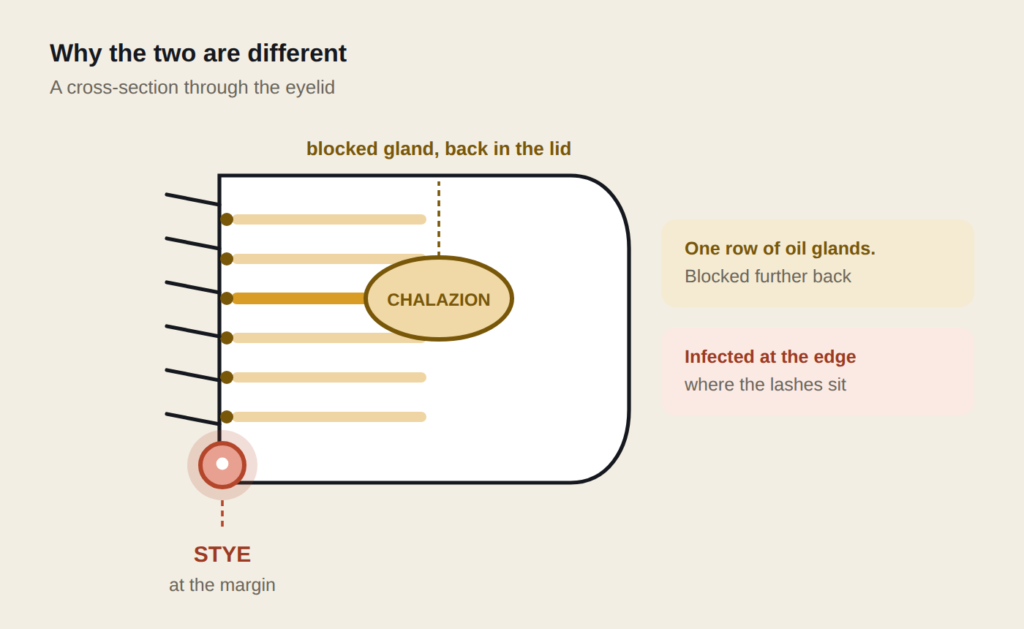
The anatomy explains the whole difference. Your eyelid has a row of oil glands running vertically through it, opening onto the lid margin just behind the lashes. An infection at the opening, or in a lash follicle, produces a stye at the edge. A blockage deeper along one of those glands produces a chalazion further back.
The AAO also splits styes in two. An external stye starts at the base of an eyelash and looks like a pimple. An internal stye forms inside the lid, in one of the oil glands, and is the one most often mistaken for a chalazion early on.
Does a chalazion hurt?
Not usually, and that absence is diagnostic. A chalazion can sit there for weeks without hurting at all. Some people only notice one when they feel it with a finger or see it in a photograph. If your eyelid bump hurts to touch, you’re probably dealing with a stye.
A chalazion can still cause trouble without pain. The American Optometric Association notes that a large one can press on the surface of the eye and blur vision, and that tearing and mild irritation are common. Pressure is different from pain, and both are worth mentioning at an appointment.
Pain that gets worse rather than better changes the picture. Spreading redness across the lid or onto the cheek, swelling that closes the eye, fever, or any change in vision means an infection may be moving beyond the gland. That is a same-day call, not a wait-and-see.
How long does each one take to go away?
A stye usually starts improving within a few days of consistent warm compresses. A chalazion is much slower: the AOA says most resolve on their own within several weeks to a month, and advises contacting an optometrist if one hasn’t drained and healed within a month.
That month is the number I ask people to hold on to. Patients either panic at week one or ignore a lump for half a year. A chalazion slowly shrinking at three weeks is behaving normally. One the same size at five weeks is not going to clear itself.
How do you treat a stye or chalazion at home?
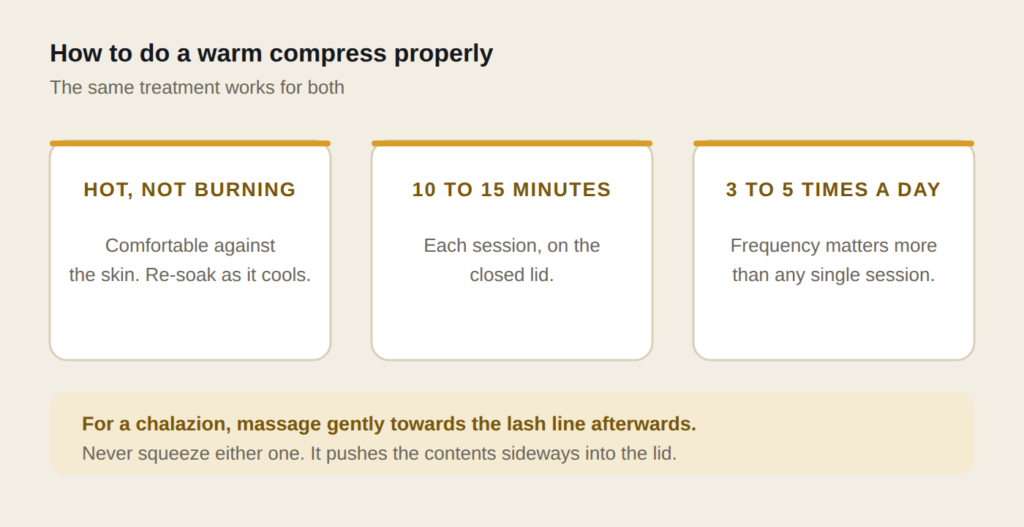
I recommend warm compresses for both, done properly and often. The AAO’s instruction is a clean washcloth soaked in hot water held against the lid for 10 to 15 minutes, three to five times a day, re-soaking it as it cools. For a chalazion, gentle massage around the area afterwards helps the blocked gland drain.
- Soak a clean washcloth in hot water. Hot enough to be comfortable against the skin, never hot enough to burn.
- Hold it on the closed lid for 10 to 15 minutes. Re-soak it whenever it cools, which will be every couple of minutes.
- Repeat three to five times a day. The AOA goes further for chalazia and suggests four to six times. Frequency matters more than duration.
- For a chalazion, massage gently afterwards. Clean finger, small circles over the lump, towards the lash line.
- Keep the area clean and your hands away from your eyes between compresses.
Do
- Use heat, often, for the full 10 to 15 minutes
- Wash hands before touching the lid
- Switch to glasses while it settles
- Replace old eye makeup after a stye
Don’t
- Squeeze or pop it. The AAO warns this can spread infection into the lid
- Wear contact lenses until it has cleared
- Wear eye makeup over it
- Reach for leftover antibiotic drops from a previous problem
I get asked why squeezing fails even when it seems to work. The contents of a stye are walled off inside a gland. Forcing them out doesn’t clear the gland, it pushes material sideways into the surrounding lid tissue, which is how a contained problem becomes a spreading one.
When should you see an eye doctor about an eyelid bump?
If a chalazion hasn’t cleared in a month, if a stye isn’t improving after a week of compresses, if your vision changes, or if the bump keeps coming back in the same place. That last one matters more than its mildness suggests.
A chalazion that returns to the same spot repeatedly should be examined rather than treated again at home. The AOA notes that chalazia often recur, and that rarely they can indicate an infection or a skin cancer. A one-off lump that clears is routine. The same lump, in the same spot, for the third time, is a reason to have the tissue looked at properly.
That is not a common outcome, and I don’t raise it to worry anyone about a first chalazion. It is why I ask whether this has happened before, because the answer changes what I examine rather than what I prescribe.
What happens at the appointment?
I examine the lid under magnification, look at the gland openings along the margin, and check that the bump is what it appears to be. Most visits end with better compress technique and a plan. Some need a steroid injection to shrink a stubborn chalazion, and a few need it drained with a small incision.
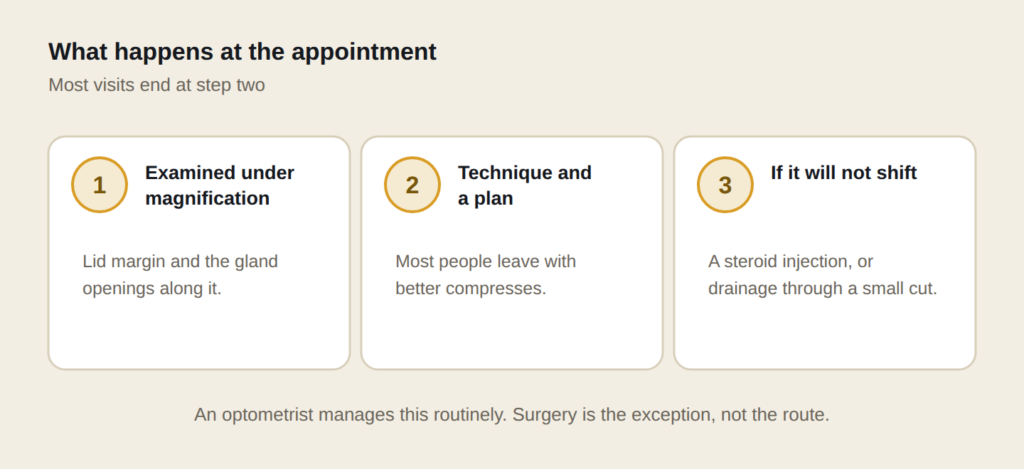
I manage this routinely in the chair. The AAO lists antibiotics for an infected stye, a steroid injection for a very swollen chalazion, and surgical drainage when a chalazion won’t resolve, along with a biopsy where there’s any doubt about what the lump is.
Things I ask about at the visit: whether you get these often, whether you have blepharitis, rosacea or seborrheic dermatitis, and whether you have diabetes. The AAO lists all of those as things that make styes and chalazia more likely, and treating the underlying cause is what stops the cycle.
Eyelid bump that isn’t shifting?
We examine and treat styes and chalazia at 100 14th Street in Jersey City, inside Target Optical, seven days a week. Most medical and vision plans accepted, including Medicare and Medicaid.
If you’ve already worked out it’s a stye and you want the treatment detail, we’ve covered that separately in our guide to getting rid of a stye. For a red eye without a lump, pink eye or allergies is the more likely question.
Frequently asked questions
Is a stye or chalazion contagious?
A chalazion is not contagious at all, because there’s no infection involved. A stye is caused by bacteria, but the bump itself doesn’t spread from person to person the way pink eye does. The sensible precautions are the ordinary ones: don’t share towels, pillowcases or eye makeup, and wash your hands after touching the lid.
Can I wear contact lenses or makeup while it heals?
No to both until it has cleared. The AAO is specific about not wearing eye makeup or contact lenses with a stye or chalazion. Lenses trap bacteria against an already irritated lid, and makeup blocks the same gland openings you’re trying to clear. Throw away any mascara or eyeliner you used in the days before a stye appeared.
Can a chalazion affect your vision?
A large one can. The AOA notes that a chalazion pressing on the surface of the eye can blur vision, usually by slightly distorting the shape of the cornea underneath. It resolves when the chalazion does. Any vision change that comes on with eye pain or spreading redness is a different matter and needs seeing promptly.
Owner and lead optometrist at Vista Vision in Jersey City, focused on glaucoma and dry eye. View full profile
This article is general information, not medical advice, and it cannot diagnose a lump you can see in the mirror. If an eyelid bump is painful, changing, affecting your vision, or returning to the same spot, see an optometrist or ophthalmologist.