
Glaucoma Symptoms: The Ones You Notice, and the Ones You Won’t

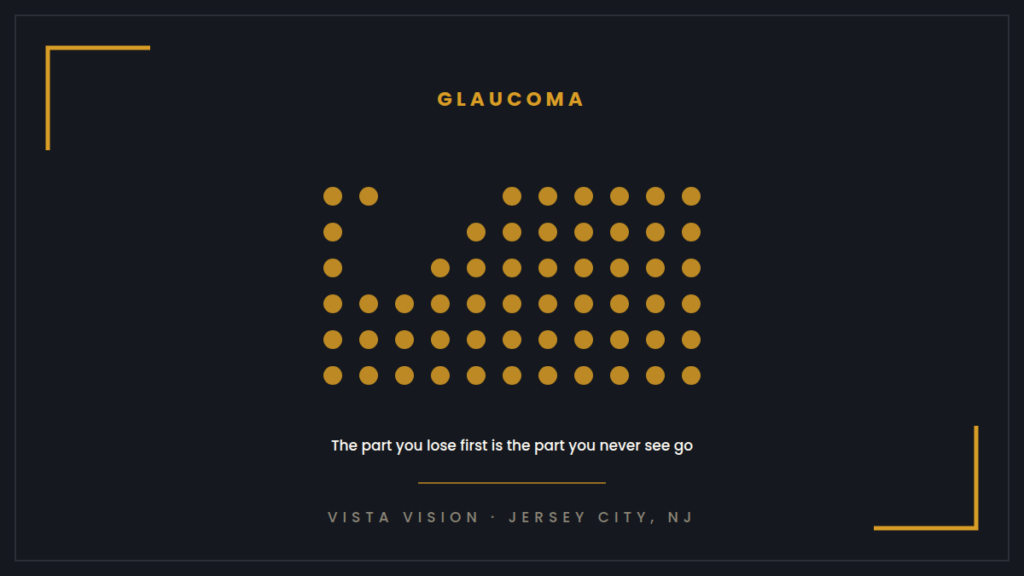
The common form of glaucoma has no symptoms at all until damage is already done. The National Eye Institute puts it plainly: glaucoma “doesn’t usually have any symptoms,” which is why half the people who have it don’t know. There’s one exception, acute angle-closure glaucoma, and that one is a same-day emergency.
Quick Takeaways
- Open-angle glaucoma, the common type, is silent. No pain, no blur, no warning.
- The first thing lost is peripheral vision, and your brain hides the gap from you.
- Acute angle-closure is the opposite: sudden pain, nausea, halos, a red eye. Go now.
- 4.22 million US adults had glaucoma in 2022. Around half don’t know it.
- Treatment stops glaucoma getting worse. It can’t give back what’s gone.
What are the symptoms of glaucoma?
For most people, there aren’t any. The National Eye Institute states that at first glaucoma “doesn’t usually have any symptoms,” and the American Optometric Association describes the common form as developing “slowly and painlessly, with no early warning signs.”
Glaucoma isn’t one disease. It’s a group of them, and they damage the optic nerve, the cable carrying vision from your eye to your brain. Two forms account for almost everything people mean by the word, and they behave in completely opposite ways.
Open-angle glaucoma is the common one and it is silent. Acute angle-closure glaucoma is uncommon, unmistakable and urgent. Almost every symptom list online blends the two, which is how an alarming set of symptoms ends up attached to a disease that usually causes none.
| Open-angle glaucoma | Acute angle-closure glaucoma | |
|---|---|---|
| How common | The large majority of cases | Uncommon |
| Onset | Years, often decades | Hours |
| Pain | None | Intense eye pain |
| What you notice | Nothing, until side vision is already gone | Halos around lights, blurred vision, red eye, nausea |
| How it’s found | A routine dilated eye exam | You know something is badly wrong |
| What to do | Book an exam on schedule | Emergency care the same day |
What is usually the first sign of glaucoma?
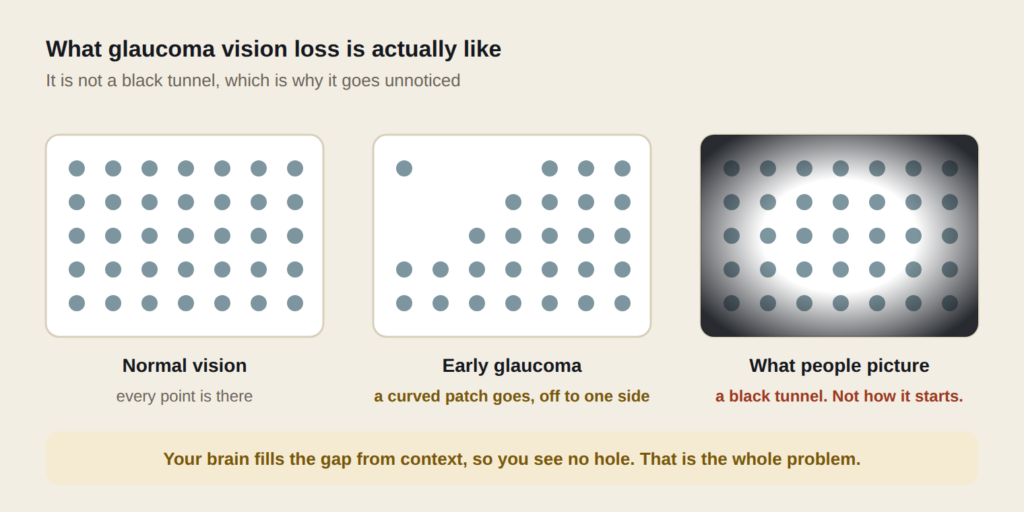
Peripheral vision, and you almost certainly won’t notice it going. The NEI describes vision loss that starts “with your side (peripheral) vision.” The gap appears off to the edge of what you’re looking at, and your brain fills it in from context so convincingly that most people never see a hole.
Patients expect losing vision to feel like losing vision. It doesn’t. Your visual system papers over missing information, and it does that whether the gap comes from a normal blind spot or from nerve damage.
What people eventually report to me is vaguer than a blind spot. Clipping the doorframe with a shoulder. Missing a cup on the table’s edge. Finding night driving harder than it used to be. Those aren’t symptoms anyone connects to an eye disease, which is why they rarely trigger an appointment.
At first, glaucoma doesn’t usually have any symptoms. That’s why half of people with glaucoma don’t even know they have it.
National Eye InstituteWhen glaucoma is an emergency: acute angle-closure
Acute angle-closure glaucoma is the one form that announces itself. The NEI lists intense eye pain, nausea, a red eye and blurry vision, and says it needs immediate emergency care. The AOA adds halos or colored rings around lights. This is not a wait-and-see situation.
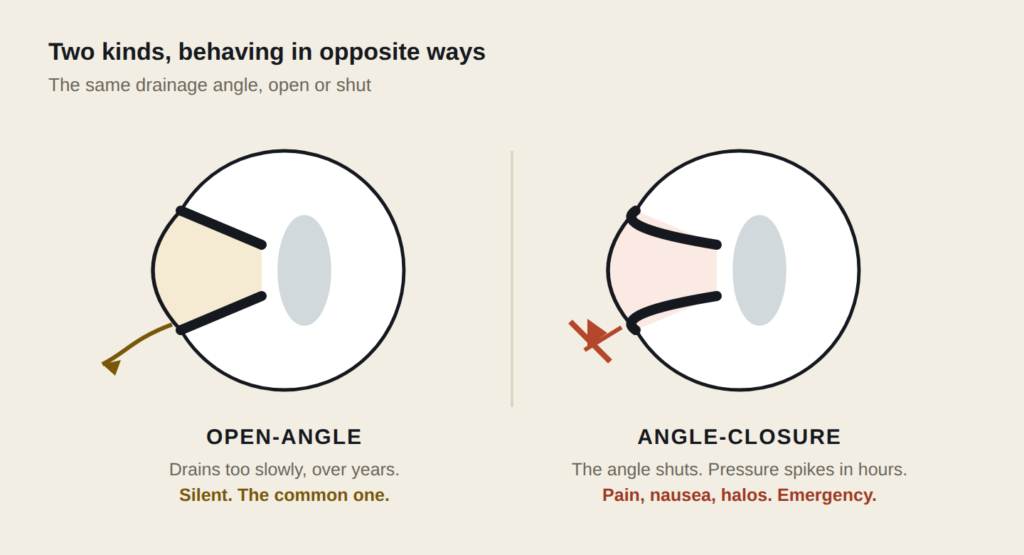
Here the drainage angle inside the eye closes off suddenly and pressure climbs within hours rather than years. The pain is severe enough that people often assume it is a migraine and treat it as one, which costs time the optic nerve doesn’t have.
If you have sudden severe eye pain with nausea, halos around lights and a red eye, seek emergency care now. Not tomorrow, not at your next appointment. Vision lost to an untreated attack does not come back.
Sudden vision changes in one eye have several possible causes, not all of them glaucoma. We’ve written separately about what sudden blur in one eye can mean and when it needs same-day attention.
Who gets glaucoma?
More people than the old figures suggest. A 2024 analysis in JAMA Ophthalmology estimated 4.22 million US adults were living with glaucoma in 2022, which is 2.56% of adults over 40. Age, family history, African or Hispanic ancestry and diabetes all raise the risk.
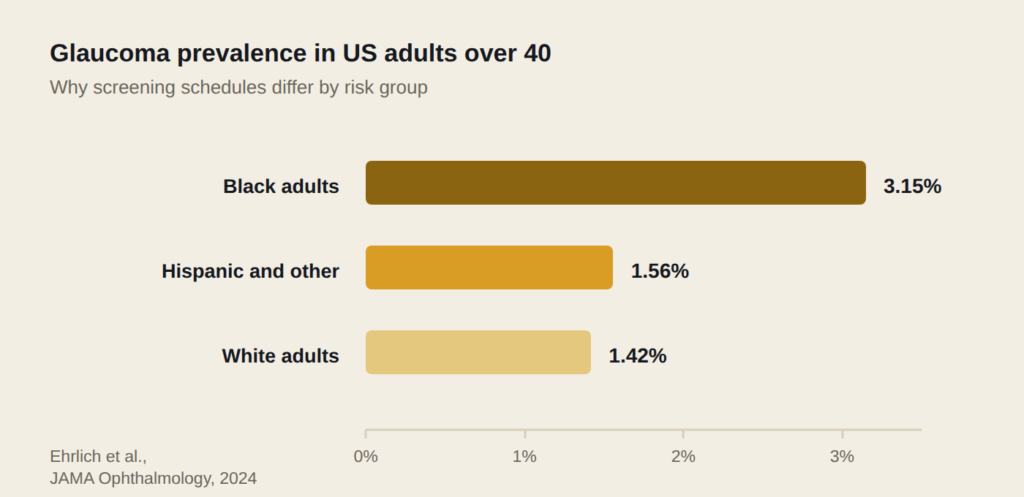
Those figures come from Ehrlich and colleagues in JAMA Ophthalmology, published October 2024. The same study found 1.49 million people had glaucoma severe enough to affect their vision.
The risk isn’t spread evenly. That study put prevalence among Black adults at 3.15%, against 1.42% among White adults, with Hispanic and other groups combined at 1.56%. You’ll see much larger multiples quoted elsewhere, including on some government pages, but this is the current peer-reviewed estimate and it’s the one worth planning around.
The AOA also lists high blood pressure, heart disease, previous eye injury, thinner corneas and long-term corticosteroid use among risk factors, and notes that people of Asian descent face higher risk of the angle-closure type specifically. The CDC states that people with diabetes are twice as likely to develop glaucoma, which is one of several reasons a diabetic eye exam looks at more than the retina.
How is glaucoma actually found?
In a comprehensive dilated eye exam, before you have any complaint. The NEI names the dilated exam plus a visual field test that checks side vision. Because the disease is silent, the exam is not confirming something you noticed. It’s finding something you can’t.
A pressure reading alone isn’t enough, which is the thing I most often have to explain. Plenty of people with raised eye pressure never develop glaucoma, and some develop it at pressures considered normal. The AOA lists several tests because no single one decides it.
- Tonometry. Measures the pressure inside the eye. Useful, but only one input.
- Dilated optic nerve exam. Looks directly at the nerve head for the pattern of damage glaucoma leaves.
- Visual field testing. Maps the side vision you can’t self-assess, and catches loss before you’d ever notice it.
- Pachymetry. Measures corneal thickness, because a thin cornea makes pressure readings misleading and is a risk factor in itself.
- Optic nerve imaging. Records the nerve so this year’s scan can be compared against next year’s.

A single visit tells me where you are. A series tells me whether anything is changing, and change is what I make treatment decisions on.
If you’re at higher risk, the NEI’s guidance is a comprehensive dilated eye exam every one to two years. Medicare covers a glaucoma screening once every 12 months for people it classes as high risk, which includes anyone with diabetes or a family history of glaucoma.
Can glaucoma be cured or reversed?
No, and that’s the reason the rest of this matters. The NEI is direct about it: “Treatment won’t undo any damage to your vision, but it can stop it from getting worse.” Optic nerve fibers don’t regenerate. What’s gone is gone.
Treatment works, though, and it works well in my experience. Drops that lower eye pressure are usually first, with laser treatment and surgery available when drops aren’t enough. The goal throughout is to hold the line where you are now.
Which reframes the whole question you came in with. If you’re searching for symptoms, you’re hoping for a signal that tells you when to act. Glaucoma doesn’t give you one. The only thing that catches it early enough for treatment to protect a full field of vision is an exam you booked when nothing was wrong.
Getting checked for glaucoma in Jersey City
Glaucoma screening is part of a comprehensive eye exam at Vista Vision, seven days a week at 100 14th Street inside Target. If you’re over 40, have a family history, or have diabetes, that exam is the entire early-detection strategy. There isn’t a symptom to wait for.
Tell me when you book if glaucoma runs in your family. It changes what I test and how closely I track it year to year, and family history is the risk factor patients most often forget to mention.
You can see what else a comprehensive eye exam covers, or read more about how we approach diagnosing and managing eye disease.
Frequently asked questions
Can glaucoma be reversed?
No. Treatment lowers eye pressure to stop further damage, but vision already lost to optic nerve damage doesn’t return. This is why glaucoma is worth catching in an exam rather than waiting for something to change.
Does high eye pressure always mean glaucoma?
No, and low pressure doesn’t rule it out. Many people have raised pressure and never develop glaucoma, while others develop it at pressures within the normal range. Pressure is one reading among several, which is why a proper assessment looks at the optic nerve and the visual field too.
How often should I be checked for glaucoma?
The NEI recommends a comprehensive dilated eye exam every one to two years if you’re at higher risk, meaning over 60, over 40 and African American, or with a family history. Medicare covers an annual glaucoma screening for people meeting its high-risk criteria.
Book a comprehensive eye exam
Seven days a week at 100 14th Street, inside Target. Most medical and vision plans accepted, including Medicare and Medicaid.
Owner and lead optometrist at Vista Vision in Jersey City. Glaucoma detection and management is one of his two main clinical interests, alongside dry eye. View full profile
This article is general information, not medical advice, and it can’t diagnose you. Sudden severe eye pain with nausea, halos and a red eye needs emergency care the same day. For anything else, book a comprehensive eye exam.