
Lazy eye in children: why glasses come before the patch

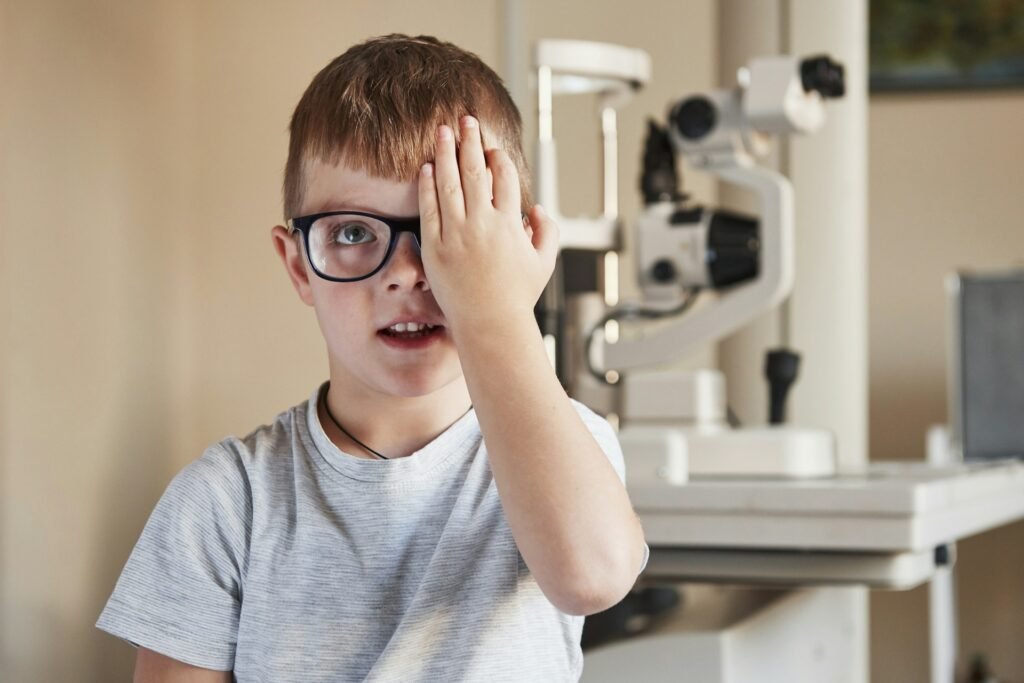
Most parents come in looking for a wandering eye. That is what the phrase describes, so that is what they watch for. The problem is that the commonest form of lazy eye produces two eyes that point perfectly straight and look entirely normal.
Which is why I usually find it, rather than a parent noticing it.
Lazy eye, or amblyopia, is reduced vision in one eye because that eye and the brain never learned to work together properly. Up to 3 in 100 children have it, and in most of them nothing is visible from the outside. It does not resolve on its own, and the first treatment is almost always glasses rather than a patch.
Quick takeaways
- Amblyopia is a vision problem, not an appearance. Most affected children have two straight eyes.
- Glasses alone resolved it completely in 27% of children in one study, and improved it in 77%.
- Patching is added only if a gap remains after a glasses trial of roughly 14 to 16 weeks.
- It does not go away by itself. Waiting is the only part of this that reliably costs vision.
- Treatment after age seven still works. In one trial, 53% of 7 to 12 year olds improved.
What is lazy eye in children?
Lazy eye, clinically called amblyopia, is reduced vision in one eye because the brain and that eye never developed a proper working connection in early childhood. The National Eye Institute says up to 3 out of 100 children have it. It is the eye’s wiring to the brain that is affected, not the eye itself.
During the first few years of life the brain is learning to interpret what each eye sends it. If one eye sends a blurrier or more confusing image than the other, the brain quietly starts favoring the better one. The weaker eye is often structurally healthy. It simply never got the practice.
That is what separates it from an ordinary prescription problem. Glasses sharpen the image arriving at the eye. Amblyopia is about what the brain learned to do with that image, which is why treatment is partly about giving the weaker eye something to do.
What causes lazy eye in children?
Three causes account for most cases: one eye needing a much stronger prescription than the other, an eye that turns in or out, and something physically blocking a clear image such as a childhood cataract. The National Eye Institute also notes that in many cases no cause is identified.
The first of those is the one that catches families out. When one eye needs a far stronger prescription than its partner, both eyes look identical and move identically. Nothing is wrong with how they sit in the face. The child has no reason to mention it, because as far as they know this is simply what seeing looks like.
An eye that turns is the visible cause, and the one people associate with the term. A childhood cataract is rare but the most urgent, because the blockage has to be cleared before anything else helps.
What does lazy eye look like in a child?
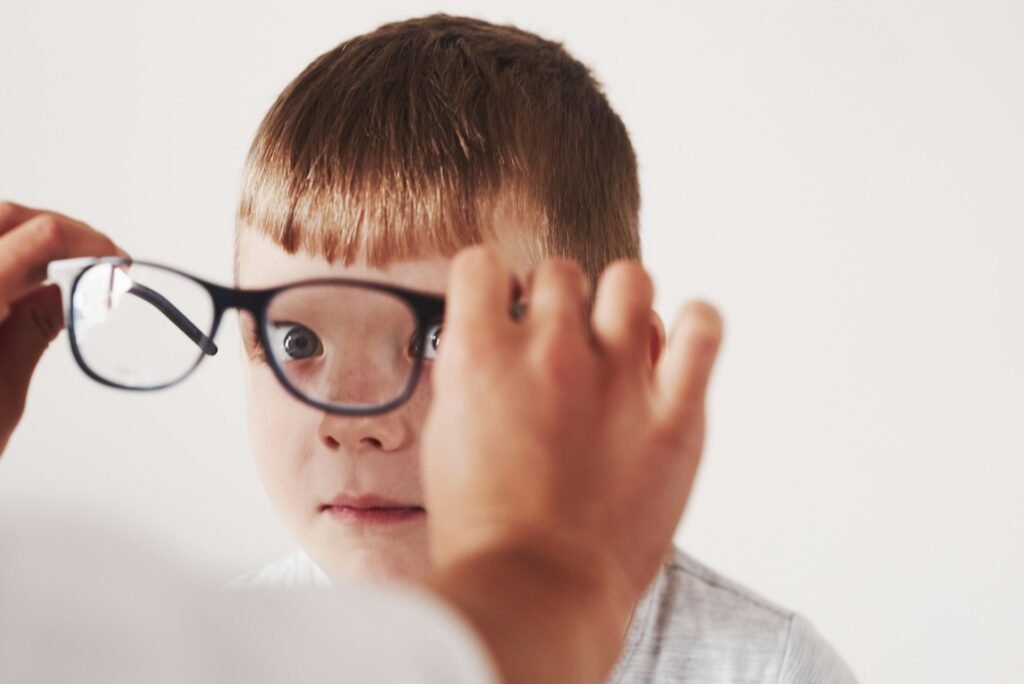
Usually it looks like nothing at all. Because the commonest cause is an unequal prescription between two straight eyes, amblyopia is normally found by measuring each eye separately at an exam rather than spotted at home. A visibly turning eye is one route to amblyopia, not its usual sign.
There are things worth watching for and worth acting on. None of them is reliable, and a child can show none of them and still have a real difference between their eyes.
Worth booking an exam
- Tilting or turning the head to look at something
- Closing or covering one eye to focus
- Sitting very close to screens or holding books at the face
- Clumsiness or trouble judging distance, especially on stairs
- Objecting strongly when you cover one particular eye
Come in without waiting
- An eye that turns in, out, up or down at any age
- A white or unusual reflection in flash photographs
- A family history of lazy eye, squint or strong prescriptions
- A drooping eyelid covering part of the pupil
- Sudden blurred or double vision
The fuller list is in my guide to the signs your child needs glasses. The signs are useful when present and prove nothing when absent.
Can a child outgrow lazy eye?
No. Amblyopia does not resolve on its own, and the National Eye Institute states that without treatment children may have lifelong vision problems. The brain responds best to treatment in early childhood, so delay is the one choice here with a measurable cost.
This is the most expensive belief I encounter. A child doing well at school, running around normally and never complaining looks like a child with nothing wrong, and in every respect except one they are. The weaker eye causes no trouble precisely because the stronger one has taken over the work.
If you are weighing up whether to wait and see: there is no version of amblyopia that gets easier to treat later. Every month of waiting spends part of the window in which the brain is most willing to change.
What can be mistaken for a lazy eye?
Pseudostrabismus, which AAPOS defines as eyes that look like they are not straight but actually are. A flat nasal bridge and folds of skin at the inner corners make a baby’s eyes appear crossed, most obviously in photographs taken as they glance sideways. It needs no treatment.
Most babies grow out of the appearance as the bridge of the nose develops, and it is one of the more reassuring things I get to tell a parent.
AAPOS states the important qualification directly: a baby with pseudostrabismus can still go on to develop a genuine eye turn. A harmless appearance today does not exempt the child from being checked. An alignment test takes moments and settles it either way.
How is lazy eye treated in children?
Glasses come first. The American Academy of Ophthalmology says spectacle correction alone is often the first line of therapy, and in one study of unequal-prescription amblyopia, vision improved by two or more lines in 77% of patients and resolved completely in 27%. Patching is added only if a gap remains.
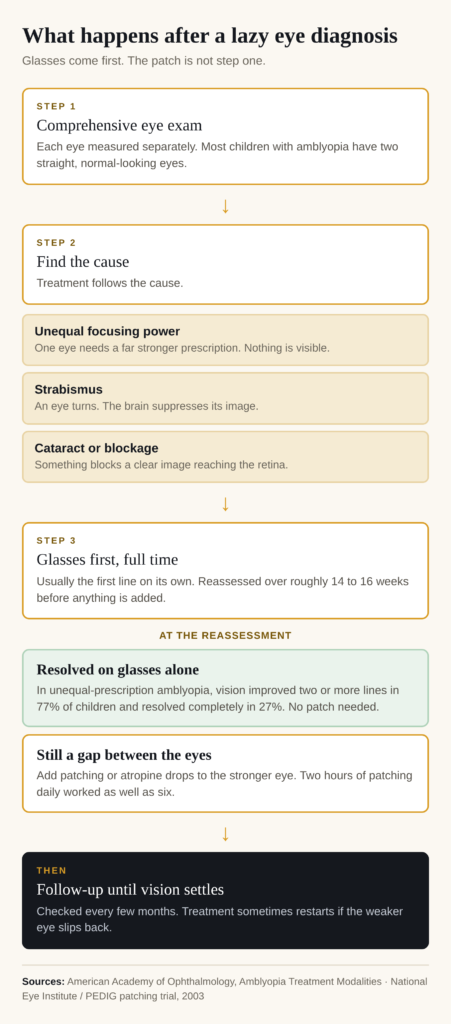
That figure is the one I wish more parents arrived knowing. The patch has become the public image of amblyopia treatment, and for a good share of children it never leaves the drawer. The AAO notes progress on glasses alone is reassessed across about 14 to 16 weeks, with some children still gaining beyond 30.
Where glasses are not enough, the next step blurs or blocks the stronger eye so the weaker one has to work. That is either a patch or a daily atropine drop, and they are alternatives rather than a ladder.
- Glasses, worn full time. Often the whole treatment. Reassessed after roughly 14 to 16 weeks before anything else is considered.
- Patching the stronger eye. In the PEDIG patching trial, two hours a day worked as well as six across 189 children with moderate amblyopia, average age 5.2. That study dates from 2003 and still underpins how patching is dosed.
- Atropine drops instead. One drop a day blurs near vision in the stronger eye. Useful where a patch becomes a daily argument, which it often does.
- Follow-up until vision settles. Checked every few months, because the weaker eye can slip back and treatment sometimes has to restart.
Where the problem is how the two eyes work as a pair rather than how each one sees, vision therapy may be part of the plan. That is a different question from amblyopia and the two get conflated more often than they should.
Is it too late to treat lazy eye after age seven?
No. In a trial of 507 children aged 7 to 17 across 49 eye centers, 53% of those aged 7 to 12 improved by two or more lines on glasses, patching and near work, against 25% on glasses alone. Among 13 to 17 year olds who had never been treated, 47% improved against 20%.
The line that it is hopeless after seven circulates widely and is not what the evidence says. Those figures come from the National Eye Institute’s 2005 report on the trial, and they changed how older children are managed.
The same report is clear about the limit, and so am I: most children who responded were still left with some visual impairment. Later treatment is worth doing and it is not the same as early treatment. A parent deciding whether to bother at eleven deserves both halves of that.
Does lazy eye need surgery?
Usually not. Surgery straightens an eye that turns, which is a different job from treating the amblyopia behind it. A child who has surgery for an eye turn generally still needs glasses, patching or drops afterwards. The exception is a childhood cataract, where the blockage has to be removed first.
Strabismus and amblyopia get discussed as one thing. They are related and not identical: the turn is a problem of alignment, the amblyopia a problem of vision, and fixing the first does not fix the second.
Where surgery is on the table, that is an ophthalmologist’s decision rather than mine. I examine, diagnose, prescribe and manage the non-surgical treatment, and refer when a case needs it. The full distinction is in my piece on the difference between an optometrist and an ophthalmologist.
When should my child’s eyes be checked?
The American Optometric Association recommends a comprehensive assessment between 6 and 12 months, at least one exam between the ages of 3 and 5, another before first grade, then annually. Those ages are set where they are because amblyopia is found by measuring, not by looking.
A school or pediatric screening passing is not the same as an exam finding nothing. Screenings are quick pass-or-fail checks, and a child with one strong eye can pass on that eye alone. That is how amblyopia goes unnoticed for years in a child whose parents did everything they were asked to.
Book your child an eye exam in Jersey City
We see children seven days a week at Target Optical, Newport. Walk in, or request a time and we will confirm by email.
Frequently asked questions
Can a lazy eye correct itself?
No. Amblyopia is a difference in how the brain uses each eye, and it does not reverse without treatment. A child may appear to be managing well, which usually means the stronger eye is compensating rather than that the problem has gone.
Is lazy eye permanent?
Untreated, the reduced vision generally becomes permanent. Treated, most children gain vision, though the 2005 National Eye Institute report notes many who respond are left with some impairment. Earlier treatment produces better outcomes, which is the argument for early exams.
Does my child have to wear the patch all day?
No. In the PEDIG trial, two hours of daily patching produced the same improvement as six hours across 189 children with moderate amblyopia. Your optometrist sets the dose for your child, but the long days of patching that parents dread are not the standard.
Can adults be treated for lazy eye?
Treatment is less effective in adults than in children, according to the National Eye Institute. Trial results in older teenagers show real gains, so adulthood is not an automatic no, but expectations differ and the evidence is thinner.
Does lazy eye run in families?
A family history of amblyopia, squint or strong prescriptions raises a child’s risk and changes what gets tested. Tell your optometrist when you book rather than at the end of the appointment.
Owner and lead optometrist at Vista Vision, inside Target Optical at Newport, Jersey City. He sees children seven days a week and his clinical interests are glaucoma and dry eye.
This article is general information, not a diagnosis. If you are concerned about your child’s eyes, book an examination rather than acting on anything you have read here.