How to Read Your Eye Prescription


O.D. is your right eye and O.S. is your left. SPH is the strength of the lens, and the minus or plus sign tells you whether you’re nearsighted or farsighted. CYL is how much astigmatism you have, AXIS is the angle it sits at, and ADD is extra power for reading.
Below is a sample card with every box labeled, what each number means for your eyes, and how long it stays valid in New Jersey.
Quick Takeaways
- The sign in front of SPH matters more than the number. Minus is nearsighted, plus is farsighted.
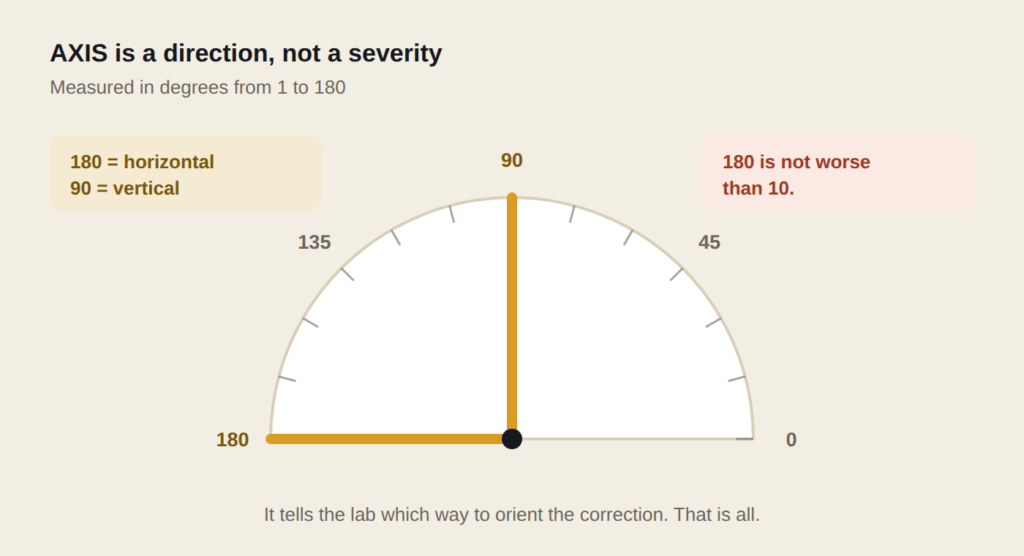
- AXIS is measured in degrees from 1 to 180. It describes direction, not severity.
- A glasses prescription will not buy contact lenses. They are two different prescriptions.
- In New Jersey, contacts can’t be dispensed more than two years after the prescription was written if no expiry date is on it.
- Federal rules say your prescriber must hand you a copy without you asking, and can’t charge for it.
What does an eye prescription look like?
A grid with two rows and three to five columns. The rows are your eyes, labeled O.D. and O.S. The columns are the measurements. The rest is admin: your name, the exam date, the prescriber’s details and an expiry date.

O.D. and O.S. come from Latin, oculus dexter and oculus sinister. Some practices write RE and LE instead. O.U. means both eyes together. Your two eyes almost never have identical numbers, and in my chair a small difference is ordinary.
What does SPH mean on an eye prescription?
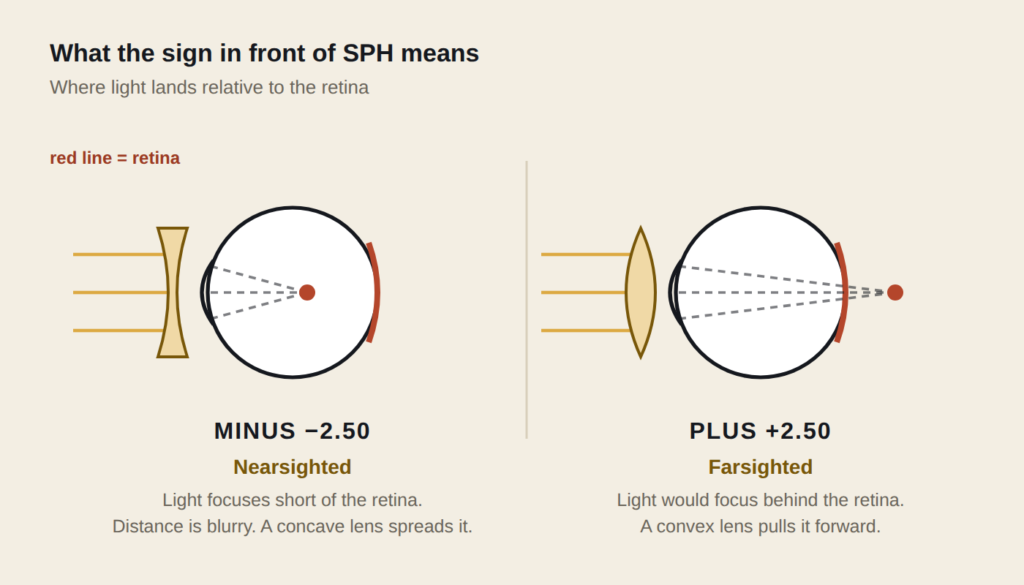
SPH, or sphere, is the main lens power, measured in units called diopters. A minus sign means you’re nearsighted and struggle with distance. A plus sign means you’re farsighted. The further the number sits from zero, the stronger the lens.
So −2.50 and +2.50 are the same strength of lens doing opposite jobs. The American Academy of Ophthalmology describes sphere as the lens power needed to correct your vision, with zero needing none.
If the box reads plano, or PL, or just a dash, your sphere is zero and that eye needs no distance correction. Plano in one box and a number in the other is common.
What do CYL and AXIS mean?
CYL is how much astigmatism you have, also in diopters. AXIS is where that astigmatism sits, written in degrees from 1 to 180. The two always appear together, because a correction for astigmatism is meaningless without knowing which way to orient it.
An eye with astigmatism is curved more steeply in one direction than another, so light entering one way focuses at a different depth from light entering the other. CYL is the size of that mismatch, AXIS the direction the correcting power has to point.
An AXIS of 180 is not worse than an AXIS of 10. It’s the one number on the card that isn’t a measure of how bad anything is. 180 means horizontal, 90 means vertical, and everything between is a rotation. Patients see a large number, assume a large problem, and I undo more of that worry than anything else on the card.
If CYL is blank, has a dash, or says DS or SPH, you have no significant astigmatism and the axis box will be empty too. We go into what that curvature actually does to your vision in our guide to the astigmatism test.
What is ADD on a glasses prescription?
ADD is extra magnifying power added to the bottom of the lens for close work. It’s always a plus number, and it’s usually the same for both eyes. It appears once the focusing muscle inside the eye stiffens with age, which starts for most people in their forties.
An ADD of +2.00 on a distance prescription of −2.50 means the reading portion works out at −0.50. That’s the arithmetic behind bifocals and varifocals: the add layers on top of your distance correction.
What is PD, and why isn’t it always on the card?
PD is pupillary distance, the gap between the centers of your pupils in millimeters. It tells the lab where to place the optical center of each lens. It is a dispensing measurement rather than a clinical one, which is why some prescriptions don’t include it.
Get the PD wrong and the lenses induce a small prism effect, producing eye strain and headaches that feel like a wrong prescription but aren’t. Online retailers ask for it because they can’t measure it. We can, in under a minute.

Some cards also carry PRISM and a BASE direction, a correction that shifts the image where the eyes don’t align perfectly. It’s uncommon, and I’d have explained it at your appointment if you had one.
Is my eye prescription bad?
The question I’m asked most. The number describes how far light focuses from your retina, not the health of your eye. Someone at −6.00 with healthy eyes is in better shape than someone at −0.75 with early glaucoma. Strength and health are separate things, and only one of them is on the card.
| SPH range | Usually described as | What it tends to mean day to day |
|---|---|---|
| Under 1.00 | Very mild | Many people only wear glasses for driving or screens |
| 1.00 to 3.00 | Mild to moderate | Glasses most of the time for distance |
| 3.00 to 6.00 | Moderate to high | Glasses or contacts needed for most activities |
| Over 6.00 | High | Full-time correction, and worth regular retinal checks |
High myopia is the one case where the number carries clinical weight, because a longer eye stretches the retina and raises the risk of retinal problems later. I treat it as a reason for thorough retinal examinations rather than alarm at the figure.
How long is an eye prescription valid?
Whatever expiry date your prescriber wrote on it. If no date is written, New Jersey rules stop a dispenser supplying contact lenses more than two years after the prescription was issued. Glasses prescriptions have no equivalent state expiry, though most practices write one.
New Jersey’s dispensing code, N.J.A.C. 13:33-4.1, sets that two-year ceiling for contacts with no stated expiry, and the same two-year limit applies to lenses mailed to you. The FDA notes that where a state sets no minimum, federal regulation defaults to one year.
Two rights worth knowing
You get a copy automatically. Under the FTC’s Eyeglass Rule and Contact Lens Rule, your prescriber must give you your prescription without you having to ask, can’t charge you for it, and can’t make you buy glasses or lenses to get it.
Contacts come after the fitting, not the exam. A contact lens prescription is finalized once the fitting is complete, which can take more than one visit. Ask for a later copy and the prescriber has 40 business hours to supply it.
Can I order contacts with my glasses prescription?
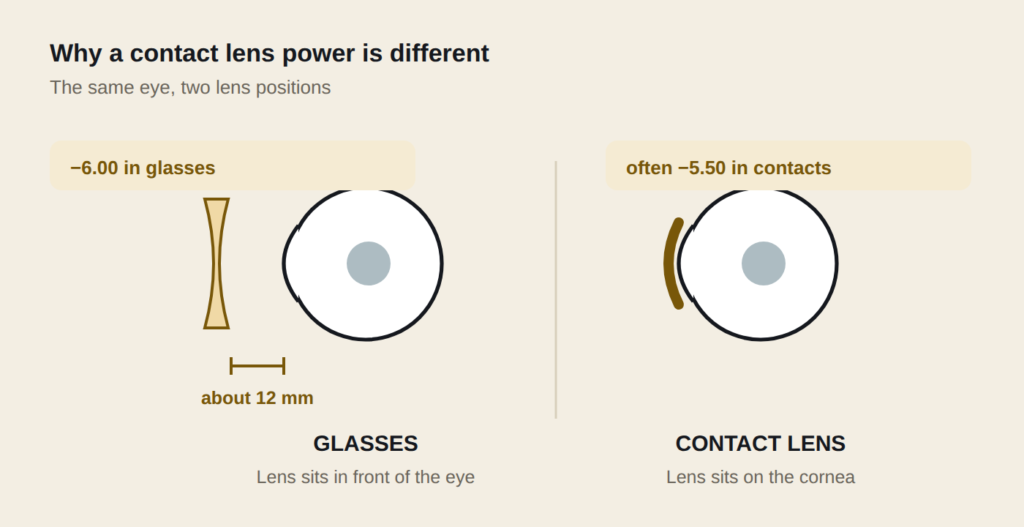
No. A contact lens prescription carries measurements a glasses prescription doesn’t have: base curve, diameter, and the specific brand and material. It also uses different powers, because a contact lens sits on the eye while a spectacle lens sits twelve millimeters in front of it.
That distance changes the math. At low powers the difference is negligible, but past about 4.00 diopters the contact lens power has to be reduced for the same correction. It’s why a −6.00 glasses wearer is often a −5.50 in contacts.
The FDA lists what a contact lens prescription must contain to be fillable, including the lens power, material or manufacturer, base curve and diameter. A glasses card carries none of those.
When should you get a new prescription?
When it expires, or sooner if anything has changed. Blur creeping back at distance, headaches after screen work, or a reading add that no longer reaches all mean the numbers have moved since they were measured.
Book a routine exam
- Your prescription has expired or is close to it
- Vision is slightly blurrier than it was
- You hold your phone further away to read it
- Two years since the last one, or one if you wear contacts
Get seen sooner
- Vision changed over days rather than months
- One eye has changed and the other hasn’t
- New floaters, flashes or a shadow in your side vision
- Your prescription climbs sharply at every visit
A prescription that jumps a long way in a short time I investigate rather than simply dispense. Rapid shifts can follow blood sugar changes in diabetes, and steadily steepening astigmatism in a younger patient prompts a check for keratoconus.
Prescription expired, or not reading as well as it did?
We’re at 100 14th Street in Jersey City, inside Target Optical, seven days a week. Bring your current glasses and your old prescription if you have it, and we’ll tell you exactly what has changed. Most medical and vision plans accepted, including Medicare and Medicaid.
Frequently asked questions
What does 20/20 have to do with my prescription?
Nothing directly. 20/20 is a measure of how much detail you can resolve on a chart, recorded during the exam. Your prescription is the lens power that gets you there. Two people can both see 20/20 in their glasses while holding completely different numbers on their cards.
Why is my new prescription different at two opticians?
Small differences between examiners are normal, because refraction partly depends on your answers. A quarter of a diopter either way is within ordinary variation. A difference larger than that is worth querying, and if you bring both cards I can usually work out which one matches how you actually see.
Can I use my prescription to buy glasses online?
Yes, and you’re entitled to a copy for exactly that purpose. You’ll need the PD as well, which is often missing from the card because it’s a dispensing measurement rather than a clinical one. Any optician can measure it for you. What an online order can’t do is check your eye health, which is the part of the appointment the prescription doesn’t capture.
Owner and lead optometrist at Vista Vision in Jersey City, focused on glaucoma and dry eye. View full profile
This article is general information, not medical advice, and the sample prescription shown is illustrative. Expiry rules and dispensing requirements vary by state and by prescriber. Check the dates printed on your own prescription, and see an optometrist if your vision has changed.