
Astigmatism Test: How to Check, and What It Can’t Tell You

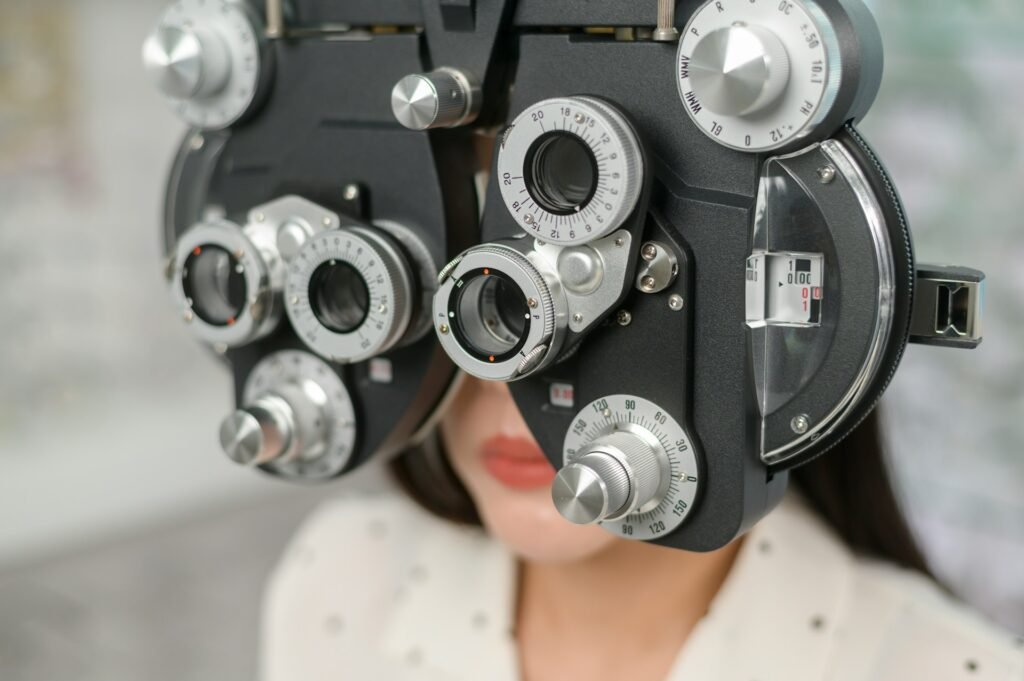
A home astigmatism test uses a dial chart: if some spokes look darker or sharper than others, that points to astigmatism. It takes ten seconds, and it’s genuinely useful as a prompt. What it cannot do is measure how much you have, which direction it sits in, or whether something else is blurring your vision. Those need a keratometer and a refraction.
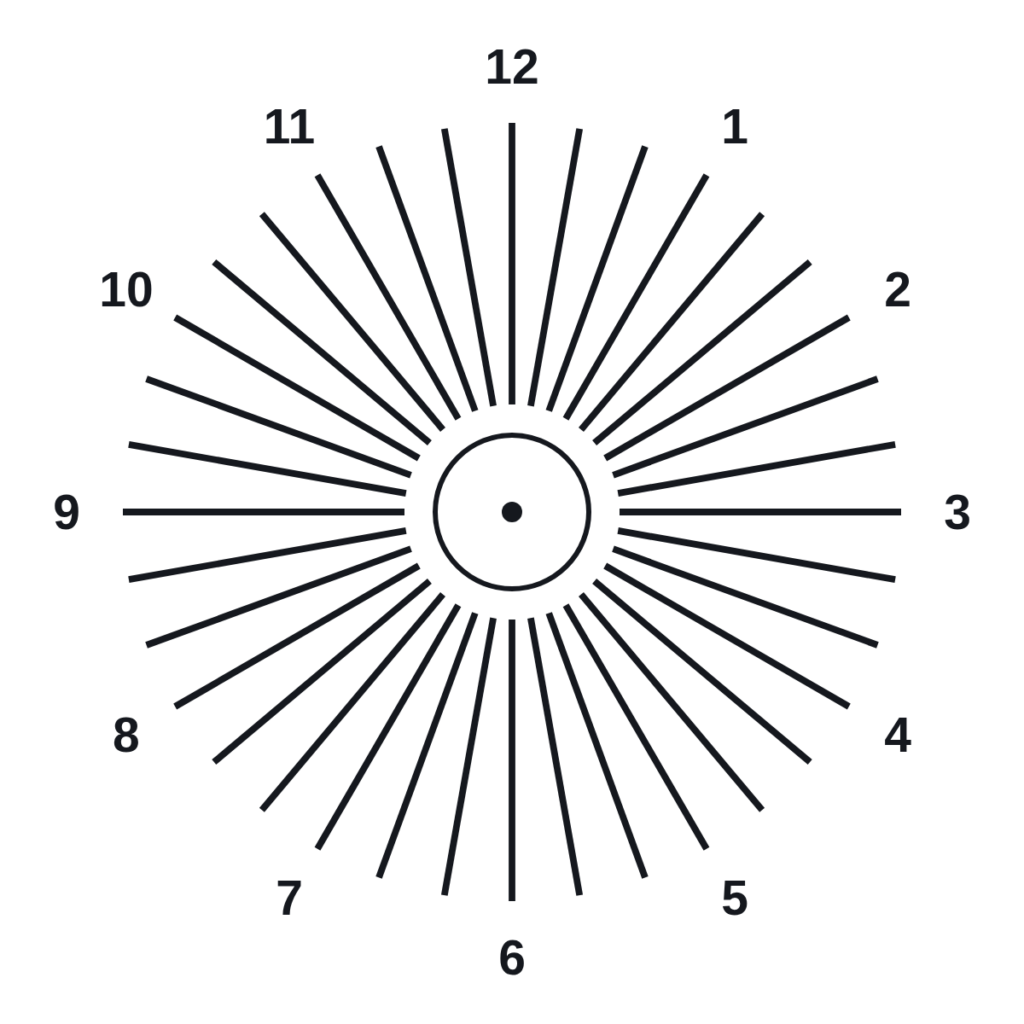
There’s a dial chart below you can use right now. Then the rest of this explains what your result actually means, and what happens in the chair that a screen can’t reproduce.
Quick Takeaways
- Astigmatism affects 36.2% of US adults, so a positive result is unremarkable rather than alarming.
- The dial test detects the possibility of astigmatism. It measures nothing.
- Your eye doctor uses four instruments, and only one of them is the lens-flipping part.
- Online tests replace the refraction alone, which is one element of about eight.
- No one knows what causes astigmatism, and nothing prevents it. Glasses, contacts or surgery correct it.
Can you test for astigmatism at home?
You can screen for it, which is not the same as testing for it. Cover one eye, look at the center of the dial below from about arm’s length with your glasses or contacts off, and see whether every spoke looks equally dark and equally sharp. Then swap eyes.
Reading your result
- All spokes look the same. No sign of significant astigmatism in that eye.
- Some spokes look darker, sharper or more solid. That direction is where your eye focuses best, and the blurrier direction is where it doesn’t. This is the pattern astigmatism makes.
- One area looks smudged or doubled. Worth an exam, and not only for astigmatism.
- The two eyes disagree. Common, and one reason a single pair of glasses often has different numbers for each eye.
Do it in decent light, on a screen at normal brightness, and don’t squint. Squinting narrows the aperture your eye is working through and temporarily sharpens everything, which is exactly the compensation that hides astigmatism day to day.
What does the dial test actually tell you?
That one meridian of your eye focuses light differently from another. It does not tell you how much, in what axis, or whether the cause is your cornea or the lens inside your eye. Those three numbers are what a prescription is made of, and a chart on a screen cannot produce any of them.
A normal cornea is shaped roughly like a section of a football turned on its side: curved about the same amount whichever way you slice it. An astigmatic cornea is closer to the back of a spoon, steeper across one direction than the other. Light entering the steep direction focuses at a different depth from light entering the shallow direction, so no single point on the retina is ever fully in focus.
That is why the spokes differ. The ones aligned with your eye’s sharper meridian land on the retina cleanly; the ones ninety degrees away land in front of or behind it. The dial reveals the mismatch without measuring it.
A dial result cannot separate astigmatism from other causes of directional blur. Dry eye, an irregular cornea, early cataract and keratoconus can all make a dial look uneven. That is the case for having the finding checked rather than self-treating it.
How do eye doctors test for astigmatism?
Four measurements, in sequence. Visual acuity establishes how much vision you’ve actually lost. Keratometry measures the curvature of your cornea. Corneal topography maps its whole surface. Refraction then finds the lens combination that corrects what the first three found.
- Visual acuity. The letter chart. As the AOA puts it, “when you read letters on a distance chart, you are measuring your visual acuity,” reported as a fraction such as 20/40. It sets the baseline everything else is measured against.
- Keratometry. The keratometer is “the primary instrument used to measure the curvature of the cornea,” and it does it by “focusing a circle of light on the cornea and measuring its reflection.” A perfectly round reflection means an evenly curved cornea. An oval one is astigmatism, and its shape gives both the amount and the direction.
- Corneal topography. A topographer “generates a contour map of the cornea,” which catches irregularity a keratometer’s single ring can miss. This is the step that distinguishes ordinary astigmatism from a cornea changing shape for another reason.
- Refraction. The phoropter, the instrument that “places a series of lenses in front of your eyes and measures how they focus light.” Before that, a retinoscope or autorefractor gives a starting estimate, which is why the lens-flipping part is quicker than people expect.
The National Eye Institute notes that astigmatism is checked as part of a dilated eye exam, and that the exam is “simple and painless.” Dilation is about seeing the retina and the lens behind the cornea, not about the astigmatism measurement itself.
Why isn’t an online astigmatism test a diagnosis?
Because it attempts to replace one element of an eye examination. The American Optometric Association’s position is that online vision tests only try to reproduce “the refraction,” and “do not include a comprehensive examination of the patient’s eye health.”
| What gets checked | Dial or online test | Eye exam |
|---|---|---|
| Whether astigmatism might be present | Yes | Yes |
| How much, and in which axis | No | Yes |
| Corneal shape and regularity | No | Yes |
| Eye pressure, for glaucoma | No | Yes |
| Peripheral vision and depth perception | No | Yes |
| Pupil response, for neurological signs | No | Yes |
| Retina, for tears and detachment | No | Yes |
| Blood vessels, which show blood pressure and cholesterol | No | Yes |
The AOA’s warning is specific: skipping the examination risks “irreversible vision loss or worsening of a systemic disease.” Their point isn’t that a screen gets the prescription wrong. It’s that the prescription was never the part of the appointment that protects your sight.
What do the astigmatism numbers on a prescription mean?
Two figures describe it. CYL, the cylinder, is how much astigmatism you have in diopters. AXIS, from 1 to 180, is the direction it sits in. A CYL of −0.75 at AXIS 180 and a CYL of −0.75 at AXIS 90 are the same amount of astigmatism rotated ninety degrees, and they need completely different lenses.
That 36.2% figure comes from the National Health and Nutrition Examination Survey, which autorefracted a nationally representative sample of 12,010 adults and counted anyone with a cylinder of 1.0 diopter or more (Archives of Ophthalmology, 2008;126(8):1111–19). Astigmatism is the most common refractive error in American adults, ahead of myopia at 33.1%.
Prevalence also rises with age. The same survey found people aged 60 and over were more likely to have astigmatism than younger adults, which is part of why a clean dial test at thirty says nothing about your eyes at fifty-five.
When should you book an astigmatism test?

If the dial looked uneven, or if headlights streak at night, or if you get eye strain and headaches after reading. The NEI lists blurry vision, squinting, headaches, eye strain and trouble seeing at night as the usual signs, and notes that mild astigmatism often causes none of them.
Book a routine exam
- The dial looked uneven in one or both eyes
- Headlights streak or flare at night
- Eye strain or headaches after screens or reading
- You squint without noticing
- It’s been two years, or one if you wear contacts
Get seen promptly
- Vision changed over days or weeks
- Blur in one eye only, and new
- Sudden floaters or flashes of light
- Your prescription keeps climbing at each visit
- Eye pain, or light that has become painful
A prescription that keeps increasing matters more than the number itself. Astigmatism that grows steadily, particularly in a younger patient, is the pattern that prompts a topographer check for keratoconus rather than another lens change.
If the night-time streaking is the symptom you recognize most, we’ve written about that on its own: why astigmatism makes headlights streak and halo. For what the condition feels like more broadly, see our guide to astigmatism symptoms.
Get it measured properly in Jersey City
Seven days a week at 100 14th Street, inside Target Optical. Keratometry, topography and a full refraction, and we’ll tell you what the numbers mean rather than just handing them over. Most medical and vision plans accepted, including Medicare and Medicaid.
Frequently asked questions
How accurate is an online astigmatism test?
As a yes-or-no prompt, reasonably good: an uneven dial usually does mean astigmatism is present. As a measurement, it has no accuracy at all, because it produces no number. Screen size, viewing distance, brightness and your own squinting all change the result, and none of them are controlled when you take it at home.
Can astigmatism go away on its own?
It changes over a lifetime rather than resolving. The axis and amount both shift gradually, and the NEI is clear that doctors don’t know what causes astigmatism and there’s no way to prevent it. Eye exercises, supplements and vision-training programs do not alter corneal shape. Glasses, contact lenses and refractive surgery correct it.
Do I need a dilated exam to check for astigmatism?
The astigmatism measurement itself doesn’t require dilation. The NEI describes astigmatism being checked as part of a dilated eye exam because dilation is what lets your optometrist see the retina and the lens inside the eye, where the conditions that also cause blur are found. For a first visit or if you have any risk factors, it’s worth having.
Owner and lead optometrist at Vista Vision in Jersey City, focused on glaucoma and dry eye. View full profile
This article is general information, not medical advice, and the dial chart above is a screening prompt rather than a diagnostic test. A result either way does not replace an eye examination. If your vision has changed, see an optometrist or ophthalmologist.